Book Review: Samantha Harvey's Orbital
Special Note: The following review may contain several spoilers. If you wish to read this book through a fresh perspective, please refrain from viewing this article until after completing the novel.

When you anticipate a book about astronauts embarking on a mission towards the vast cosmic realm, you might expect noteworthy tales of adventure and action. Popular sci-fi stories like Star Wars, Star Trek, Ender’s Game, and more held the standard of riveting space journeys, seeking new challenges against the unfathomable force beyond the blue sky.
But with Samantha Harvey, the journey to the cosmic unknown could also accentuate a retrospective discussion of what we’ve always had, and its priceless value through an outside scope of view.
Harvey’s Orbital guides us through the daily routine of the six astronauts as they embark on a nine-month mission to orbit around Earth. Traveling over seventeen thousand miles per hour above their home planet, we enter each character’s contemplative philosophies of human experiences or biology of life, while enduring their obligatory research and logistic duties. Despite being outside of Earth, Harvey captures a unique perspective through her characters:
how human curiosity leads us back to our humanness, and the gratitude we develop once it is laid before us.
With a lovely, heartwarming book that I gave a perfect rating, here are some aspects within the novel that I read with such awe, due to its thought-provoking and emotionally poetic prose, illustrating the consciousness of being and the gratitude that follows.
Elements of Romanticism:
Despite the irony of being in a spaceship— which is humanity's greatest invention and beacon of intellectual advancement— our crewmen remained as grounded as ever during their interactions with one another, even with personal reflections as they view Earth below.
A story of space crewmen on their adventure outside of planet Earth, for a sci-fi concept you would expect formulas of cosmic adventure and action, driving the attention away from our home planet. Yet for this author, she intended to make this story about Earth, through the outside perspective. It was a romantic tribute to our home, where we have to look from the outside to see its beauty.
“To stand on another body of rock that isn’t the earth; is it neccesarily the case that the further you get from something the more perspective you have on it? It’s probably a childish thought, but has had an idea that if you could get far enough away from the earth you’d be able finally to understand it — to see it with you own eyes as an object, a small blue dot, a cosmic and mysterious thing. Not to understand its mystery, but to understand this it is mysterious. To see it as a mathematical swarm. To see the solidity fall away from it.” (Harvey, 77)
This quote and many more provide poetic illustrations of the planet that we instinctively took for granted, and yet has provided so much with its natural essence that we are fully aware will not live without once stripped away.
And this ironic scene for astronauts to capture that gratitude by looking at our home, through the outside, accentuates something so powerful about what we perceive of our existence against the black void called space, which we know so little about.
It somehow reminds me of one of NASA’s iconic photos, the pale blue dot:

Harvey’s philosophical perspective of our nuanced existence amidst the vast cosmic space reminded me of this iconic shot from Voyager 1. The paragraph itself could serve as the most accurate description of how it feels to look at that photo.
The Psychology of Loneliness and Human Bond:
“This thing that harbours we humans who polish the ever-larger lenses of our telescopes that tells us how ever-smaller we are. And we stand there gaping. And in time we come to see that not only are we on the sidelines of the universe but that it’s of a universe of sidelines, there there is no centre, just a giddy mass of waltzing things, and that perhaps the entirety of our understanding consists of an elaborate and ever-evolving knowledge of our own extraneousness, a bashing away of mankind’s ego by the instruments of scientific enquiry until it is, that ego, shattered edifice that lets light through.”’ (Harvey, 44)
There’s this psychology of homesickness that the author somehow accentuates, focusing the lens on humanness and the mortal consciousness of companionship that is biologically registered into our brain. Being the only one of our species to be in the vast, cosmic void, it poses this intimidating and anxious prospect of loneliness despite being physically near our planet. And through that desire to resonate with something similar, the bond between crewmen amplifies whenever someone encounters a human experience.
For instance, when Chie heard about her mother’s passing, the rest of the crewmen’s instinctive action was to rush to her side and console her, knowing that the mental toll of not being near her family may be unbearable (Harvey 11-13). To finally achieve one of humanity’s greatest achievements, only to hear that something happened to your loved one while you’re millions of miles away from your planet, is a predicament that a human being may be unable to endure alone. The support gained from her crewmates eventually helped Chie navigate through her grief as she completes her mission, demonstrating this wholesome level of camaraderie that one mandates during a difficult time.
Another example is Roman’s communication with the random strangers on Earth through radio communication (Harvey 151-156). One interesting aspect about this intent from the character parallels a real-life instance from Sergei Krikalev— the last soviet man who witnessed his country disappear before him in the middle of space. A man alone as his nation dissipates while he stays in contact with a Cuban woman through a packet radio. Roman reflects on Krikalev’s circumstance and how he must have felt, which inclined the motive to interact with random citizens as a way of (possibly) walking through his shoes:
“Velcroed to the wall in the Russion galley they have a photograph of Sergei Krikalev, the first Russion on the first expedition to the space station, the man who helped build it, the man who, before that, was sent to space by the USSR and was in order on Mir for almost six months longer than planned, because, while was there, the USSR ceased to exist and he couldn’t get home. Every day for a year he talked with a Cuban woman by packet radio who sent him news of his collapsing country. Roman’s hero, Krikalev. His idol. An uncelebrated but quiet and clever and gentle man. (Harvey 78)
Roman’s intent accentuates the heaviness that Sergei felt when he became the sole citizen of his fallen country in space; the loneliness of his existence as man propelled him to talk to anyone despite the pride he may have for his fallen country. The sad reality lies in the intent; where companionship is so vital to us human beings that at least heartbreaking news from a fellow human from Earth was better than going insane.
Remembering Artemis II:
The novel’s romantic tone nearly made me forget that this novel was still set within a spaceship. Although it does have the sci-fi elements based on the plot’s preliminary objective that revolves around the space mission, the premise felt more like a love letter to humanity and life.
And one current event that greatly reminded me of this was Artemis II’s journey.

Harvey’s poetic prose and metaphorical language capture the most humane and compassionate illustration towards a love for humanity and planet Earth. The culmination of different stories and circumstances through the lens of our characters demonstrates the complexity of our existence that makes it so beautiful.
And the sense of gratitude for….life, and existing;
it makes you wonder about the wave of emotions the Artemis II crew felt during their mission. Despite the weight of their responsibility, the values they represent, and being that prestigious model of human society that believes in the possibilities of insurmountable milestones. Despite it all, the emotion they expressed was a reflective yet elated emotion of gratitude for their journey.
And as the audience, we develop this new perspective, without having to be an astronaut ourselves, and it makes us feel blessed for the life we consciously strive to fight and sustain.
It’s this indescribable feeling that even artificial intelligence can replicate. I wish there was a word that I could articulate right now, but it’s this mix of compassionate awareness, gratefulness, and platonic and romantic love for humanity and our purpose of living.
Overall Rating: 5/5
A space mission meant to create new milestones became a circumstance for Harvey to give us a retrospective view of awareness for our biological existence, and such value exceeds the need to always wanted something new or better. I finished this novel with a greater sense of emotional awareness of things I took for granted, down to the most basic human necessity. Because without our mother planet, an author writing about space and the philosophical ideals of a meaningful life would cease to exist.
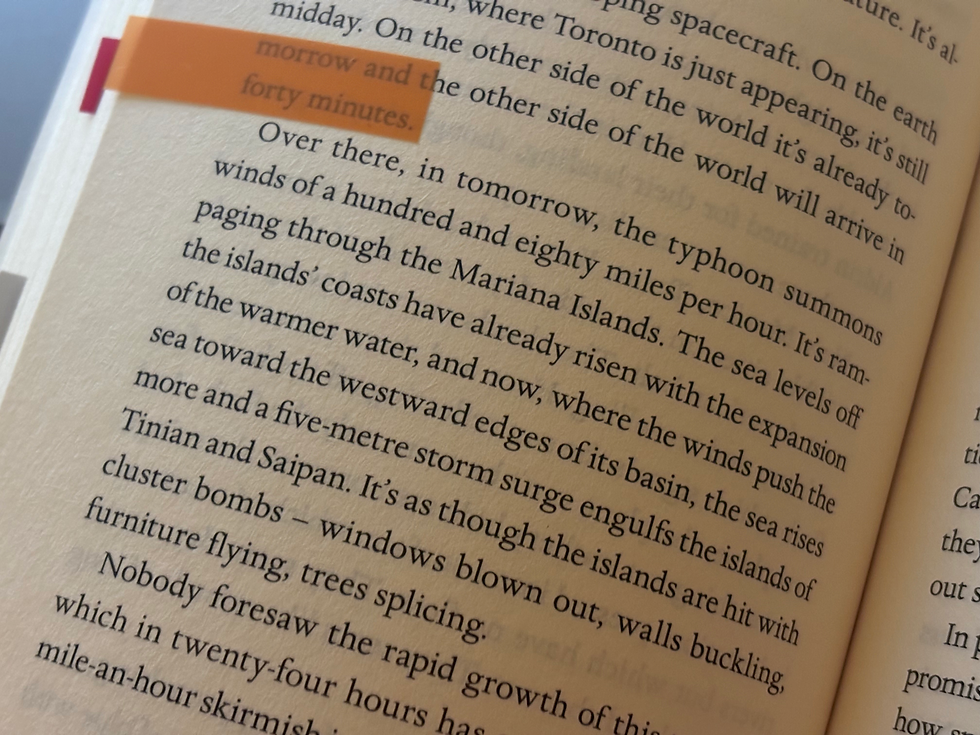
Bonus: It was such a rare occurrence for the Marianas Islands to be featured in her novel. Although the premise of the scene related to an anticipated super typhoon (which was very much true ), a simple indication of our region had filled me with so much pride knowing that Ms. Harvey took notice of the minority. She has officially become one of my favorite authors.
Sources:
Harvey, Samantha. Orbital. Grove Press, 2023.


Comments